
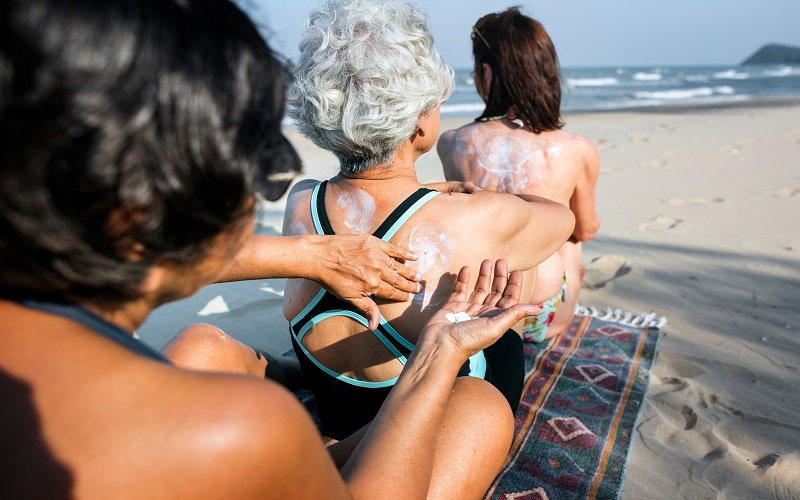
Summertime is often when we remember to use sunscreen and other skin protection, but really, we should take precaution year round–even here in the cloudy Pacific Northwest! We sent 5 questions to Marcus Tan, MD, a board-certified dermatologist and fellowship-trained Mohs surgeon with Valley’s Dermatology Clinic, to discuss skin protection and changes to watch for on our skin, and to get a primer on what Mohs surgery is and how it is used to treat skin cancer.
1. What should I do daily to care for my skin? Any extra precautions needed in summer?
I often tell my patients that sun protection should not be reserved for vacations. Rather, it should be a daily habit, much like brushing our teeth. Even during routine activities like commuting to work or walking the dog, cumulative sun exposure adds up. Here are some sun safety tips:
- Use a broad-spectrum sunscreen with SPF 30 or higher every morning. If outdoors, reapply every 2 hours without exceptions.
- I am a fan of UV-blocking apparels. A wide-brim hat that protects the ears and back of the neck, and UV-blocking sunglasses. Many patients forget the back of their hands while driving. I recommend keeping a pair of UV arm sleeves in the car for your daily commute.
- Stay under a shade during peak UV hours (typically 10 AM to 4 PM).
- Avoid tanning beds entirely. There is no such thing as a “safe, base tan.”
2. How common is skin cancer?
Skin cancer is the most common cancer in the world, including in the U.S. The American Academy of Dermatology Association estimates that about 1 in 5 Americans will develop skin cancer in their lifetime.
The most common types of skin cancers are basal cell carcinoma (BCC) and squamous cell carcinoma (SCC), which are usually highly curable when caught early. Melanoma is less common but carries a much higher risk of spreading, hence why early detection is crucial. With better awareness and regular skin checks, most skin cancers are detected early and successfully treated.
3. What should I look for when doing a self-skin check?
Many of my patients have heard of the “ABCDEs” (asymmetry, border, color, diameter, evolving), which are helpful for identifying melanoma.
However, for more common BCC and SCC, a key warning sign is a growth or a patch that bleeds easily and does not heal within 1–2 months. If something looks different from your other spots or is non-healing after several months, it needs to be evaluated by your care team and considered for a biopsy.
4. I’ve heard Valley’s dermatologists offer something called Mohs surgery. Who might need this procedure and what does it entail?
Dermatologists will often recommend Mohs surgery for skin cancers located in cosmetically or functionally important areas like the face, ears, hands, or feet. Mohs surgery offers up to 99% cure rate because we examine 100% of the surgical margins while the patient waits.
Instead of taking a wide margin and sacrificing healthy tissue, I remove the visible tumor and a very narrow layer of surrounding tissue, which is processed immediately in our on-site lab. If the microscope shows cancer cells remaining, I go back and remove tissue only where those cancer cells remain. This ‘map-guided’ approach allows me to be as conservative as possible with your skin. Once we have confirmed that the margins are clear of tumor, we then discuss various repair options to ensure the best cosmetic and functional outcome. It is important to ensure that your surgeon is “fellowship-trained”, as this signifies the highest level of specialized expertise in both the Mohs surgery and reconstruction.
5. Anything else you’d like to add?
One of the most important things to watch for is the ‘stubborn’ spot. If you have a lesion that has been treated multiple times with cryotherapy (freezing) or topical creams but keeps coming back, please do not ignore it. Recurrence is a major red flag that the initial diagnosis may need to be reassessed. In my practice, these are the cases where a formal skin biopsy is essential to ensure we are not missing a more aggressive subtype of skin cancer that requires a different definitive treatment approach.
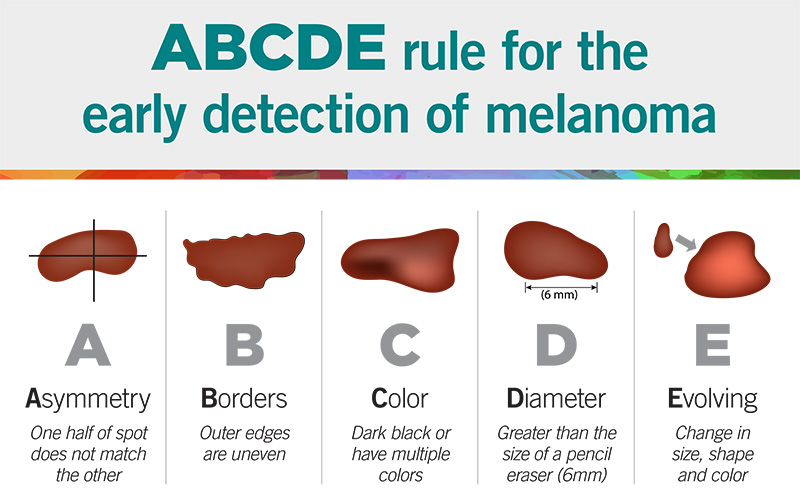
For photo examples of the ABCDEs, visit the American Academy of Dermatology’s website.
Learn more about dermatology (skin) care at Valley.
Content for this article is for educational purposes only and is not a substitute for professional medical advice.