
This article was originally published October 2024. It was reviewed and updated October 2026.
A DEXA scan, also called a bone density scan, is an imaging test that measures how strong your bones are by looking at certain bones in your body. It is an important tool, especially as you age, that helps check your risk of osteoporosis, a condition that weakens bones, making them more likely to break.
DEXA scans help providers see how your bones change over time, which can help diagnose osteoporosis early.
What is osteoporosis?
Osteoporosis is a term used to describe brittle bones and the risk for having a broken bone. As you age, your bones can lose thickness and strength. DEXA tests help your provider track your bone density and risk for having a broken bone over time. Providers often use DEXA tests to help diagnose osteoporosis.
How to Prepare for a DEXA Scan Appointment
Make sure to schedule your DEXA far enough apart from other tests, and be mindful of medication restrictions:
| Two weeks before | No oral contrast |
| Two days before | No calcium supplements (including Tums) |
| 4 hours before | No IV contrast |
For your exam, you should wear clothes that do not have metal or plastic. Two-piece outfits, such as plain tops and elastic-waisted pants, are recommended. Bras may only have elastic, no plastic or metal, and piercings below the neck must be removed.
What to Expect During a DEXA Scan Appointment
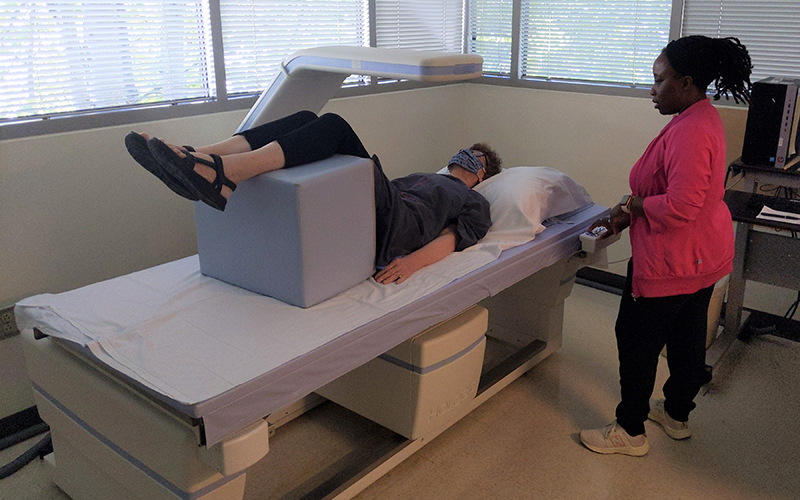
A technologist will position you lying on your back on a padded table. The machine arm above the table will emit low dose x-rays while slowly scanning over top of you. You should try to breathe like normal, but do not talk or move. Scans are painless and you will not feel anything. The technologist will scan your lower back, hip, and sometimes your wrist. Each scan takes about two minutes.
When to Expect Your Results
A radiologist will interpret the results, and they will usually be available in MyChart within 1-2 days. If you have questions, talk to your provider and they can help you understand what your results mean.
Who should get a DEXA scan or other bone density screening?
- Women over age 65
- Anyone experiencing loss of height
- Postmenopausal women with fractures (broken bones)
- Postmenopausal women under age 65 with risk factors other than menopause
- Women considering therapy for osteoporosis
- Those who are considering stopping or who have stopped hormone replacement therapy
- DEXA may be appropriate for some males over age 70 or men with certain risk factors.
- Doctors may order bone density screening for younger people if they are at high risk for breaking a bone. Talk to your provider to find out if you may be at risk. Things that increase your risk of breaking a bone include:
- Family history of osteoporosis
- Having already broken a bone as an adult
- Taking steroid medication for a long time
- Weighing less than 127 pounds
- Having rheumatoid arthritis
- Having a parent who broke a hip after a minor injury
How Often Should You Get a DEXA Scan?
How often you need a DEXA scan depends on several factors like your age, risk of fractures, and any previous scan results. Your provider will create a plan just for you to help keep your bones healthy.
Where Can You Get a DEXA Scan?
At Valley’s Breast Center, DEXA scans are available in both the Renton and Covington locations. Remember, you need a referral from your primary care provider to schedule a scan, so be sure to talk to your provider first. Your DEXA appointment can now be scheduled through MyChart. Learn how
Thank you to Marcie McCue, ARRT, Lead Mammography Technologist at Valley’s Breast Center, for speaking with us about what patients can expect leading up to, during, and after a DEXA Scan.